Skip to content

Table of Contents
That persistent shadow beneath your eyes is not always a sign of poor sleep or dehydration. For many patients, it is a structural issue rooted in gradual volume loss beneath the lower eyelid. Dermal fillers address this directly by restoring the tissue support that creates a smoother, more rested appearance. Understanding the cause behind tear trough hollowing is the first step toward choosing a treatment that actually works.
How can dermal fillers address under-eye hollowing?
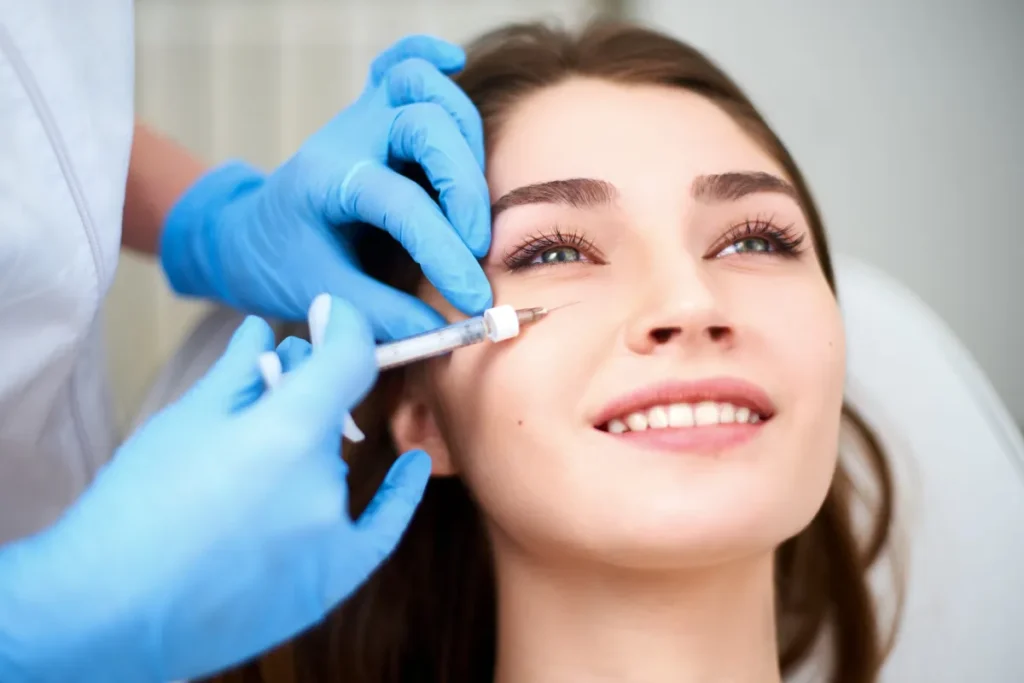
Dermal fillers restore lost volume beneath the lower eyelid by placing a biocompatible hyaluronic acid gel under the skin. The latter lifts the hollowed tissue, softens the tear trough, and reduces the shadowing that creates a fatigued appearance.
The Anatomy Behind the Shadow
The tear trough sits at the junction between the lower eyelid and the upper cheek. In younger faces, fat compartments in the midface sit high and dense, creating a smooth, continuous surface from the eye down to the cheek. With time, those fat pads gradually thin and shift downward. The result is a visible groove where fullness once existed, and because the skin in this region is exceptionally thin, even a modest dip in volume casts a noticeable shadow.
Facial volume loss causes vary from patient to patient. Aging is the primary contributor for most, as both soft tissue and underlying bone change progressively over the decades. The orbital bone itself remodels with age, subtly enlarging the eye socket and altering how surrounding tissue is supported. Genetics also plays a meaningful role. This could mean that some patients develop tear trough hollowing in their twenties due to inherited facial structure, with little relation to lifestyle or habits.
Prolonged sun exposure is another significant contributor to accelerated volume loss. Much like sun-damaged hands treatment addresses UV-related collagen breakdown in the hands, facial tissue responds to cumulative solar damage in similar ways. Collagen degradation from UV exposure compounds the structural changes that come with aging, and the under-eye area (with its naturally thin, delicate skin) tends to reflect this earlier and more visibly than other facial zones.
What Fillers Accomplish — and Where
Addressing under-eye hollowing treatment with injectable filler works by replenishing volume directly in the area of deficit. A biocompatible gel is introduced beneath the skin surface to physically lift the hollowed tissue, soften the depression, and allow light to travel across the face more evenly. The visual improvement (e.g., reduced shadowing, a smoother lower eyelid-to-cheek transition) comes from this structural correction rather than any change to skin tone or pigmentation.
The tear trough is rarely treated in isolation by experienced injectors. The midface and cheek contribute substantially to the support of the lower eyelid, so restoring cheek volume frequently improves the tear trough at the same time. This approach reflects a broader principle in aesthetic medicine: improving facial profile balance produces more harmonious, natural-looking results than addressing individual features one at a time.
Other areas commonly treated alongside the tear trough include the nasolabial folds, the corners of the mouth, and the chin and jawline. Softening marionette lines is a frequent companion goal, as these lines deepen through the same fat descent that affects the under-eye region. Vertical lip lines treatment addresses the fine lines that develop above the upper lip, where volume loss and repetitive muscle movement intersect over time.
Facial volume restoration is most effective when the face is considered as a connected whole. Correcting one area without accounting for adjacent anatomy can produce results that look inconsistent or isolated. Such a detail distinguishes experienced injectors from those focused only on a single zone.
The Juvederm® Line: Precision by Formulation
Not all injectable fillers behave the same way, and product selection significantly affects both safety and outcome. The Juvederm® line is formulated with hyaluronic acid, a naturally occurring polysaccharide found in skin and cartilage. Because this substance already exists in the body, it integrates well with surrounding tissue and carries a favorable safety profile. It is also reversible using a dissolving enzyme, which provides an added layer of reassurance in sensitive areas like the tear trough.
What sets the Juvederm® line apart is its range of specialized formulations. Each product within the line is engineered with distinct physical properties, allowing providers to select the right tool for each specific area. Thinner, more pliable formulations suit the tear trough and lips, where tissue is delicate and subtle correction is the goal. Firmer formulations address structural areas like the cheeks, chin, and jawline, where projection and lift are the priority. Placing the right product in the right plane at the right depth is the technical foundation of a result that looks and feels natural.
Duration varies by formulation and individual metabolism, ranging from approximately 6 to 24 months. Many patients find that periodic touch-ups allow for gradual, incremental refinement. This is an approach that tends to produce more balanced and sustainable outcomes than pursuing a single large correction.
Maintaining Your Results Over Time
Filler isn’t permanent, but consistent care keeps results looking their best.
- Treat it as an ongoing relationship, not a one-time fix — Patients who stay consistent with their provider see more satisfying long-term outcomes.
- Schedule touch–ups before volume fully fades — Refreshing early requires less product and less recovery than starting over.
- Prioritize skin health — Daily SPF, a retinoid, and proper hydration protect the tissue around treated areas.
- Limit sun exposure — UV rays speed up collagen breakdown and shorten filler’s effective lifespan.
- Watch weight fluctuations — Significant changes can shift facial fat and affect how filler settles.
- Avoid smoking — It weakens collagen production and skin integrity over time.
- Keep up with follow–ups — As the face naturally changes with age, providers can adjust placement to keep results balanced.
Icon Aesthetics and Facial Volume Restoration in Parkersburg, WV
For patients seeking facial volume restoration in Parkersburg, WV, Icon Aesthetics offers the full Juvederm® line through advanced facial balancing techniques. Treatments at Icon are designed around whole-face assessment, with the cheeks, temples, tear troughs, nasolabial folds, marionette lines, chin, and jawline evaluated together rather than in isolation. Lip treatments are a particular area of focus at the practice, approached with the same balance of technical precision and attention to natural proportion that defines the team’s broader work.
The Juvederm® injectable is placed at varying tissue depths depending on the treatment area, targeting wrinkles, volume loss, and structural refinement within a single cohesive framework. Consultations include honest discussion of expectations, product selection, and treatment sequencing. Moreover, our team offers plans tailored to each patient’s anatomy and goals.
Icon Aesthetics also offers biostimulators, including Radiesse®, Sculptra®, and Ariessence PDGF® for patients whose goals are better addressed through collagen stimulation rather than direct volume replacement.
Schedule your dermal fillers consultation today.
Frequently Asked Questions
How long do Juvederm® fillers last in the tear trough area?
Depending on the specific formulation used and individual metabolism, results in the tear trough typically last between 9 and 18 months before a touch-up is needed.
Can dermal fillers correct both under-eye hollowing and other facial concerns in the same appointment?
Yes. Experienced injectors frequently treat multiple areas such as the cheeks, marionette lines, and lips in a single session as part of a comprehensive facial balancing approach.
Am I a good candidate for tear trough filler?
Ideal candidates have visible under-eye hollowing with good skin quality and eyelid support, though a thorough consultation is the only way to determine the most appropriate treatment for your specific anatomy.